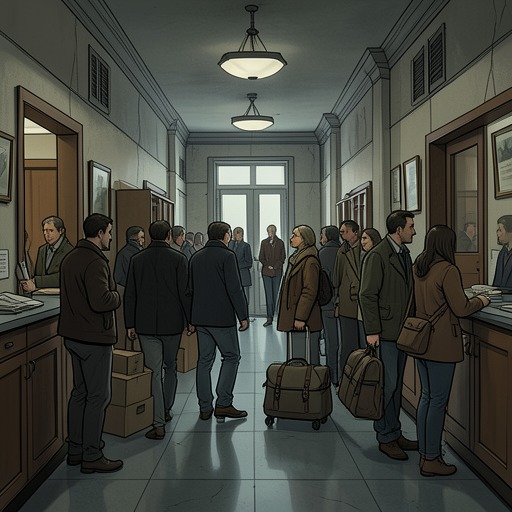
Marianne leaves secondary school
Normal PeopleMarianne leaves secondary school after Connell tells her he will take Rachel Moran to the Debs. The decision follows an intimate conversation in which he cannot explain the difference between his relationship with Rachel and his relationship with Marianne, leaving Marianne to face both the social consequences of their separation and the humiliation she believes others will see in her absence from the event.
The break with school
In April, Marianne is sitting on Connell’s bed when he tells her about Rachel. He says the invitation is not romantic and that he and Rachel are just friends. Marianne tests that explanation against their own relationship, asking whether he means they are just friends in the same way. Connell says no: the two situations are different. When she asks whether he wants to sleep with Rachel, he says he does not feel especially inclined and already has Marianne. He calls the remark a joke, but Marianne cannot find the joke in it. She tells him she thinks he has savagely humiliated her, while he neither apologises nor admits that he has done so.
Marianne goes home and sleeps for thirteen hours. The following morning, she quits school. She sees no way to return: no one else will invite her to the Debs, and she expects the school community to know she cannot attend. The exclusion is especially pointed because she organised the fundraisers and booked the venue. In her view, even sympathy would become another form of public embarrassment. Rather than return to a school where she expects to be stared at or whispered about, she stays in her room.
Life at home and Lorraine’s support
Marianne spends whole days at home with the curtains closed, studying and sleeping at irregular hours. Her mother is furious; doors are slammed, and on two occasions Marianne’s dinner is thrown away. Marianne nevertheless insists on her right not to return, reasoning that she is an adult and cannot be made to put on a uniform and submit to other people’s scrutiny.
A week after leaving school, she encounters Lorraine cleaning the oven in the kitchen. Lorraine asks whether everything is all right. Marianne says she is not going back and explains that she gets more done studying at home. When Lorraine says that her son has told her Marianne is ignoring his calls, Marianne acknowledges that she is. Lorraine tells her that Connell does not deserve her. Marianne experiences the response as a sudden, almost panicked relief and asks Lorraine to make sure Connell does not come into the house to collect her. Lorraine says he is barred from the house. Marianne immediately qualifies her own grievance, saying he was actually fairly nice compared with other people at school. Lorraine takes off her gloves and embraces her without speaking, while Marianne insists she is fine.
Exams, departure, and the limits of escape
Marianne does not return to school except to sit her exams. By then, people are saying she has been in a mental hospital, a rumour that the narrative presents as part of the social aftermath rather than as an account of what happened to her. She interprets her relationship with Connell in ways that preserve her own bitter judgment: he did not pretend she was socially acceptable; she believes she deceived herself, and thinks he used her as a private experiment. She also recognises that he chose to be with her and enjoyed it, a fact she turns against his claim to ordinary respectability.
As she prepares to leave Carricklea, Marianne imagines packing the belongings of a new existence: jumpers, skirts, two silk dresses, flower-patterned cups and saucers, a hairdryer, a frying pan, four white cotton towels, and a coffee pot. The inventory gives departure a tangible shape, but it does not promise that relocation will transform her. She wonders what it would mean to belong in Carricklea, to greet people in the street and feel that life was happening there rather than elsewhere. At the same time, she anticipates that new people and a different place will not make her feel different inside. Leaving school thus marks a decisive escape from daily exposure, but not a resolution of her loneliness or estrangement from herself.